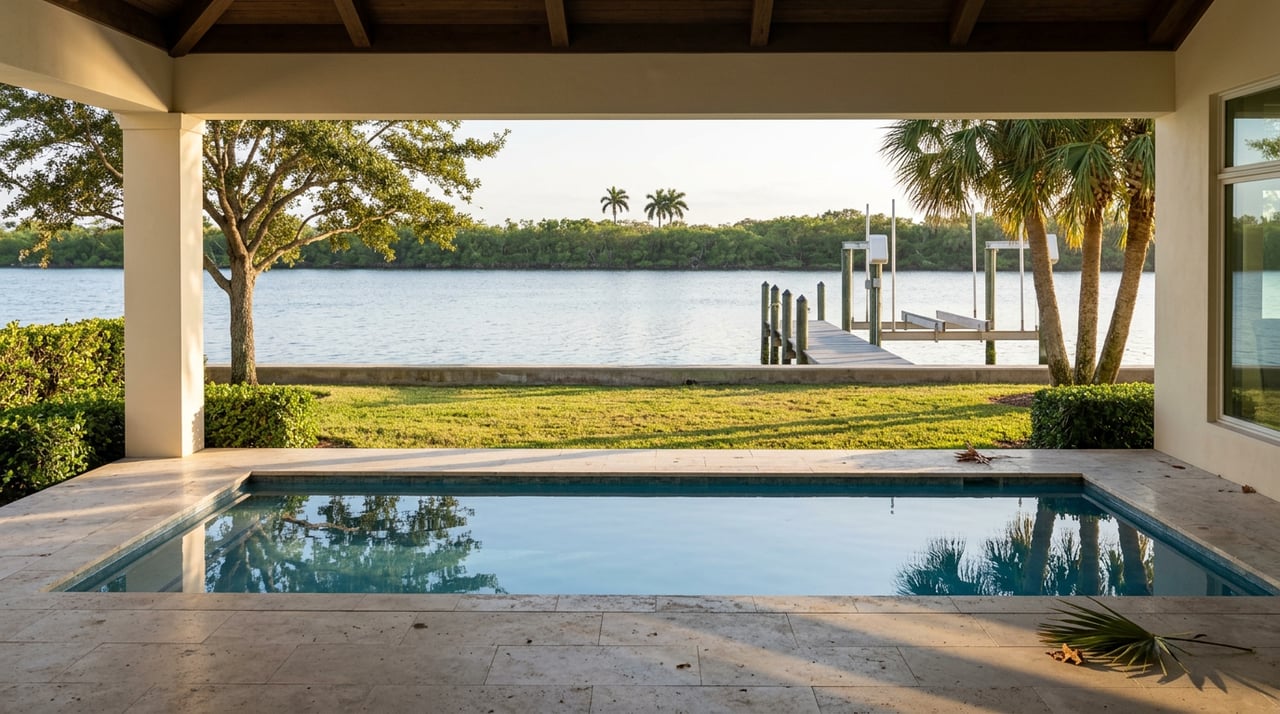
A waterfront showing in Jupiter tends to follow a set order. The buyer walks the dock first, checks how the pilings sit in the water, follows the seawall line where it meets the lawn, and only then turns to look at the house. That sequence is not incidental. Long before anyone measures a kitchen or counts bathrooms, the shoreline is already being priced, and it is being priced against a file the seller may not have finished assembling.
Most sellers assume the premium for waterfront in Jupiter is fixed, a number the market simply hands them because the lot touches the Intracoastal or the Loxahatchee River. It is not fixed. It is conditional on paperwork, and the paperwork is where negotiations quietly stall or collapse.
The Permit Is the Property
In the Town of Jupiter, docks, boatlifts, and seawalls are subject to a permitting process, and the applications typically pull in more than a local building inspector. Depending on the project, review can involve the Florida Department of Environmental Protection and the U.S. Army Corps of Engineers, alongside an HOA where one governs the parcel. The Town's own application process asks for supporting materials.
That is a longer list than most sellers expect to produce on short notice. It is also the list a serious buyer's attorney or lender will ask for once a contract is signed, so the practical move is to assemble it before the first showing rather than during due diligence, when a missing document reads as a red flag instead of an oversight.
One Unpermitted Component Can Freeze the Whole Shoreline
The detail that catches sellers off guard most often is not that permits exist. It is what happens when part of the shoreline was built or repaired without one. Unpermitted or partially permitted dock and seawall work is a common finding on older Jupiter waterfront properties, and the complication is not limited to the piece that lacks paperwork. Unpermitted shoreline work can complicate approval of later projects. A dock built in the 1990s without a permit does not just sit quietly next to a compliant seawall; it can complicate later work, such as swapping a boat lift or patching a seam.
That risk gets priced. A buyer's agent who understands the exposure will build a contingency around it, and an appraiser or lender who flags it can slow financing by weeks. Sellers who can show a clean permit history, or who disclose and price around a known gap, keep control of the negotiation. Sellers who cannot are handing that leverage to the other side of the table.
What "Waterfront" Means on the Deed Is Not One Thing
A second distinction worth confirming before listing is what the property records show about the dock and any associated rights. These details rarely show up clearly in a listing description, which means a buyer's first accurate read of what they are actually purchasing often comes from the title work, not the marketing copy. Getting ahead of that gap, by stating plainly in the listing and disclosure what type of dock right conveys, prevents a renegotiation conversation after the inspection period has already started.
The Documents Worth Having Ready Before You List
Sellers who move through this cleanly tend to gather the same handful of items before the property goes live:
- A current survey and shoreline documentation
- Copies of the dock, boatlift, and seawall permits
- Any state or federal authorizations tied to the shoreline, including FDEP or Army Corps approvals where applicable
- HOA or community association approvals for dock or seawall modifications, where a governing association applies
- Invoices or records for any marine construction, repair, or seawall work performed
- A current elevation certificate, where one exists, since lenders and insurers both request it during underwriting
None of this is exotic. It is simply easier to gather on a seller's own timeline than on a buyer's, and it reads to the other side as a property that has been maintained and documented with intention.
Insurance Has Turned the Seawall Into a Pricing Input
The permit file matters more this year than it did a few years ago because insurance underwriting has changed. Carriers writing waterfront policies in this part of Palm Beach County are now scrutinizing seawall condition, roof age, and elevation certificates more closely, alongside how windstorm and flood coverage stack together on a single property. Some owners along the Loxahatchee River have seen premiums climb by double digits year over year with no claim on record, simply because underwriting has tightened. The practical effect is that a well-documented, well-maintained shoreline is no longer just a maintenance win. It is a number an underwriter will price favorably, which flows directly into what a buyer's total carrying cost looks like and, from there, into what they are willing to offer.
The Corridor Is Being Rebuilt in Public View
Jupiter's waterfront regulatory apparatus is not a quiet backdrop. It is active, and buyers researching a purchase along the Intracoastal or the Loxahatchee River will find evidence of that quickly. In November 2024, the Town Council approved Flagler Wharf, a 12-slip marina and restaurant project off Old Jupiter Beach Road that replaces 14 older slips from a mobile home park era, with conditions barring commercial boat use, fueling, and blackwater dumping at the new docks. The approval followed two earlier, larger proposals the Council rejected as too intense for the neighborhood, a sequence that tells buyers something concrete about how closely the Town scrutinizes waterfront projects before they move forward.
The Town has also been extending the Jupiter Riverwalk, the multi-use path that runs roughly 2.5 miles along the Intracoastal from the Jupiter Ridge Natural Area north to the Jupiter Inlet. The connecting U.S. 1 bridge span reopened to bike and pedestrian traffic in April 2025, and the wider bridge and trail project was expected to reach full completion in early 2026. A short distance away, the Bureau of Land Management has been carrying out a $16 million shoreline stabilization project at the Jupiter Inlet Lighthouse Outstanding Natural Area, built to halt erosion that had been claiming roughly seven feet of shoreline a year. Construction was roughly halfway complete as of March 2026, with a retaining wall, in-water breakwaters, and a public boardwalk originally targeted for substantial completion by the end of summer 2026. None of this is decoration. It signals that federal, state, and local agencies alike treat shoreline stabilization in Jupiter as engineered work with its own permit trail, not a weekend project, which is exactly the standard a seller's own seawall file needs to meet.
What the Market Clock Actually Says
Waterfront and luxury transactions in Palm Beach County do not move on the same clock as the countywide headline number. In July 2026, single-family homes across the county reached contract in a median of 42 days, while the county's luxury segment, residential closings at $3 million and above, took a median of 63 days to reach contract that same month, an improvement from 72 days in June on 122 closings totaling $865.7 million in volume. That gap is not a sign of weaker demand. It reflects the additional diligence, financing, and documentation review that higher-value and waterfront transactions require, the same review this permit file is built to satisfy. A seller who benchmarks against the county median is likely to misjudge how long their own diligence period should run, and a seller who has already gathered the shoreline documentation is the one best positioned to keep that longer luxury-segment window as tight as it can be.
The Property You Can Actually Sell
None of this changes the appeal of owning on the water in Jupiter. It changes what determines the price a seller actually captures. A house with an unresolved seawall, an undocumented dock, or a permit that never existed is not the same asset on paper as one with a clean shoreline file, even if the two look identical from the water. The gap between them shows up in financing timelines, in negotiated repair credits, and in whether a deal closes on schedule or drifts for months while lawyers sort out what the dock actually is.
FAQ
What should I check about dock rights? Review the title work and related records to confirm what the property includes.
How much should I budget if I discover my seawall was never permitted? Seawall replacement in this market routinely runs $50,000 or more depending on length and material,
Selling waterfront in Jupiter rewards the seller who treats the shoreline file with the same discipline as the listing photos. If you are weighing a sale along the Intracoastal or the Loxahatchee River and want a second set of eyes on your permit history before you go to market, Listings & Leases offers a confidential consultation built around exactly this kind of diligence. Request Private Market Access to start that conversation.
This article is general information, not legal, tax or financial advice. Consult a qualified professional about your situation.